
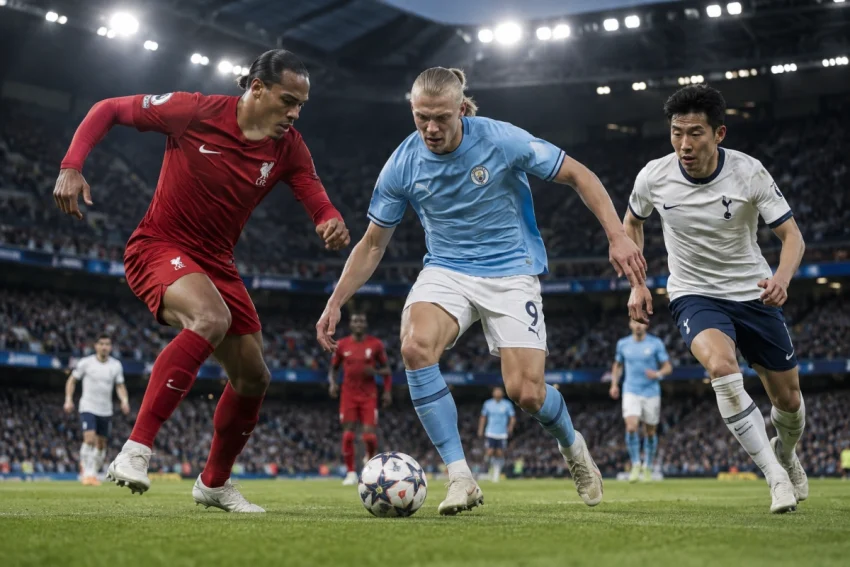
Why the Big Six Always Look “Safe” on the Coupon
Open any betting app on a Premier League weekend and the pattern repeats itself. Arsenal, Liverpool, Manchester City, Chelsea, Manchester United and Tottenham sit at odds that feel almost too low for how unpredictable football actually is.
That’s not an accident of the market. It’s a reflection of where the money goes. Bookmakers price games based on what punters are willing to stake, and Kenyan bettors — like fans everywhere — back the clubs they watch every weekend, not necessarily the ones offering the best return.
A fixture between a top-six side and a mid-table team can look one-sided on paper, but the odds often drop further than the actual form gap justifies. That’s heavy public staking doing its job, nudging bookmakers to shorten the price simply to balance their books.
When the Crowd Pushes the Price Past the Real Probability
There’s a gap between what the betting market implies and what statistical models actually calculate. Data from one well-known football analytics model last season rated a title favourite’s title chances more than 20 percentage points lower than what the bookmaker-implied odds suggested at the same point in the campaign.
That gap matters more than it looks. When thousands of bettors pile onto the same side of a market — mostly big-name clubs — the “ticket count” and the “money count” start telling different stories. One popular sportsbook even reported that Arsenal accounted for over a third of all stakes placed on title markets in a single stretch, despite Manchester United actually drawing more individual bets.
In other words, more people were backing United in small amounts, but far more money was riding on Arsenal. That imbalance is exactly what shortens a price below its true value — not better form, not stronger fixtures, just volume of cash.
For a Kenyan bettor scrolling through Premier League betting markets on a Saturday morning, this is worth sitting with for a second. Backing Arsenal at home against a relegation-threatened side might feel like the obvious tip, but the price rarely rewards that obviousness. The value, more often than not, has already drained out of the market before kickoff.
So Where Does That Leave the Smart Bettor?
None of this means avoiding the big six altogether — that would be ignoring some of the most watchable, most bettable fixtures on the calendar. It means looking at the same match through a different market.
Markets like Asian handicap, both teams to score, and draw no bet don’t just exist as alternatives for the sake of variety. They often reflect the actual balance of a match far more accurately than a straight 1X2 price distorted by public sentiment.
The next section breaks down exactly how those three markets work, and why they tend to hold up better than the obvious favourite tip when the big six are involved.
Asian Handicap: Making the Favourite Earn Its Odds
Asian handicap betting solves the exact problem created by public money — it strips out the false confidence baked into a straight win market. Instead of asking “will Manchester City win?”, it asks “will City win by more than the gap the market has already priced in?”
Take a City fixture at home to a side sitting mid-table. The 1X2 market might offer odds so short they barely cover the stake, purely because of how much cash piles onto the favourite. Shift to a -1.5 or -2 Asian handicap line on the same match, and suddenly the odds stretch back out to something worth staking on, because now the bet reflects both the win and the margin.
This matters even more in fixtures where a big-six side is only a slight favourite — away to a well-organised mid-table team, for instance. A 0 or +0.5 handicap on the smaller club effectively becomes a draw-no-bet style safety net, while still letting a bettor back the value side without worrying about a last-minute equaliser wiping out the stake.
For Kenyan bettors who follow the Premier League closely enough to judge form and injuries accurately, Asian handicap rewards that knowledge far more than a market already flattened by crowd behaviour.
Both Teams To Score: Betting on the Pattern, Not the Name
BTTS markets sidestep the “which club” question almost entirely. It doesn’t matter whether Liverpool are 80% public favourites or not — what matters is whether both sides have a defence capable of keeping a clean sheet and an attack capable of breaking one down.
This is particularly useful against the big six because several of these clubs play an attacking, high-press style that leaves gaps at the back. A match involving Chelsea or Tottenham, for example, can carry strong BTTS value even when one side is a heavy favourite on paper, simply because both teams’ underlying attacking and defensive numbers support goals at both ends.
Because BTTS odds are driven by goal-scoring data rather than club reputation, they tend to escape the inflation that comes from emotional staking. A bettor who tracks team sheets, pressing stats, and recent defensive form will usually find sharper value here than in a market crowded with casual backers of a famous badge.
Draw No Bet: Removing the Risk Public Money Creates
Draw no bet exists almost as a direct answer to the inflated favourite problem. It allows a bettor to back a big-six side without needing to absorb the shortened odds a draw outcome usually forces onto the price.
If stake gets your money back on a draw, the downside of backing a crowded favourite shrinks considerably — and the odds, while still modest, often represent fairer value than the raw win market once the draw risk is factored out.
Used selectively — say, in fixtures where a big-six club is only marginally stronger than its opponent — draw no bet becomes a way to stay involved in the popular match without paying the inflated premium that public money has already built into the straight win price.
Reading the Market Like a Trader, Not a Fan
The big six will keep topping the betting coupon every weekend, and that’s fine — the quality is real, the fixtures are worth watching, and there’s nothing wrong with having an opinion on how Arsenal or Liverpool will get on. The shift that actually improves returns isn’t about which club to support. It’s about which market reflects reality instead of reflecting the crowd.
A 1X2 price on a marquee fixture tells you what thousands of casual punters believe. An Asian handicap line, a BTTS price, or a draw no bet market tells you something closer to what’s statistically likely to happen on the pitch. Those two things overlap sometimes — but often enough, they don’t, and that gap is where value lives.
For Kenyan bettors following the Premier League closely enough to spot the difference between public sentiment and genuine form, that gap isn’t a technicality. It’s the edge. Checking data from sources like the Premier League’s official statistics hub before placing a stake — rather than relying on gut feeling about a famous badge — is a small habit that compounds over a season.
The next time a big-six fixture rolls around and the straight win price looks suspiciously thin, that’s not a signal to walk away from the match. It’s a signal to look at it differently — because the value didn’t disappear, it just moved to a market fewer people bothered to check.