
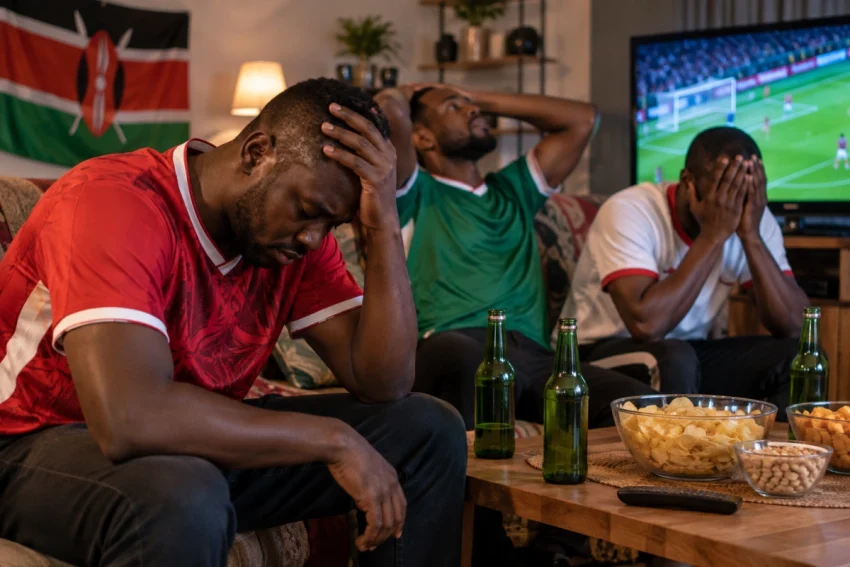
The Saturday Slip Every Kenyan Fan Knows Too Well
It’s Saturday afternoon, and the M-Pesa balance is ready. A fan opens the Premier League fixtures and picks Arsenal at home, Man City against a newly promoted side and Liverpool at Anfield. Then two more favourites go in because they “can’t lose.” Five legs at around 1.30 each turns KSh 200 into roughly KSh 740.
By the evening kick-offs, one of those “certainties” has drawn 1-1, and the slip is dead. The next week, the same fan builds the same kind of slip. This is one of the most common habits in Premier League betting across Kenya.
The instinct makes sense. Big clubs win most of their games, and short odds feel like the bookmaker saying the result is almost guaranteed. The trouble is that “almost” does a lot of work, and it gets heavier with every leg added.
What Five Legs at 1.30 Actually Add Up To
Odds of 1.30 imply the bookmaker rates a team’s chance of winning at about 77%. That sounds comfortable on its own. An acca, though, only pays if every single leg lands, so those chances multiply against each other.
- One leg at 1.30: about a 77% implied chance of winning
- Three legs at 1.30 (total odds 2.20): about 46%
- Five legs at 1.30 (total odds 3.71): about 27%
Those figures use the bookmaker’s own prices, and those prices include the house margin. A team’s true chance of winning is usually a little lower than the odds suggest. If each favourite realistically wins 70% of the time, a three-fold lands only about a third of the time, and a five-fold drops below 17%.
Put simply, that “safe” five-fold loses about five times out of six. A punter staking KSh 200 every weekend would, on average, collect once in every six Saturdays or so. Those wins usually don’t cover the stakes lost in between.
Why the Big Names Carry More Risk Than Their Prices Suggest
Short prices tell you who the likely winner is, not whether the bet is good value. They also reflect reputation and public money as much as current form. When thousands of fans pile onto Arsenal or Liverpool, the odds shrink further, whether the team is flying or not.
Recent results show how quickly this can go wrong. Arsenal were beaten 3-0 by Brighton, and Liverpool dropped points in three of their first five league games this season. Neither result was a freak event. Top sides draw away from home, rotate after European nights and run into opponents who defend deep and hit on the break.
A 1.30 leg also pays very little for the risk it adds. Removing one of those legs barely changes the potential return, but it noticeably improves the chance of the slip landing. That trade-off is where smarter acca building begins.
The good news is that avoiding favourites altogether isn’t necessary. The better question is how each one is backed, and that’s where options like draw no bet, Asian handicap and simply cutting a leg come in.
Draw No Bet: Insurance Against the Classic 1-1
Draws kill more favourite-heavy slips than outright defeats, and the Saturday slip above died exactly that way. Draw no bet removes the draw from the equation. If the team wins, the leg wins. If the match ends level, the stake on that selection is returned instead of lost.
The cost is a shorter price. A favourite quoted at 1.30 to win will be noticeably shorter on draw no bet, because the bookmaker is giving up a result that would otherwise go its way. In an accumulator, most bookmakers treat a voided leg as if it were never there. The slip continues on the remaining selections at reduced total odds instead of collapsing. Rules differ between operators, so check how your bookmaker settles void legs before relying on it.
Draw no bet works best where a draw is a realistic outcome and a defeat is unlikely. Typical examples include a top side away to a well-organised mid-table team, or a home game straight after a demanding European night.
Asian Handicap: Choosing Exactly How Much Risk to Carry
Asian handicap looks complicated at first, but it gives punters finer control than a simple win bet. The common lines break down like this:
- 0 (level ball): identical to draw no bet. A win pays, a draw refunds.
- -0.5: the same as backing the team to win outright.
- -0.25: half the stake goes on level ball and half on -0.5. A draw returns half the stake and loses the other half.
- -1: a two-goal win pays, a one-goal win refunds, and anything else loses.
- -1.5: the team must win by two or more goals.
This cuts both ways. Protective lines such as 0 and -0.25 shorten the price but soften the damage when a favourite stumbles. Bigger lines such as -1.5 lengthen the odds, which tempts punters who want one strong team to carry the slip instead of stacking five weak prices. That approach only makes sense when the gap between the sides is real. A clinical home side facing a leaky promoted team is one example. A tight derby is not.
The worst mix combines both instincts at once, stacking five favourites on -1.5 in search of a bigger payout. That multiplies difficult outcomes instead of easy ones.
Dropping a Leg: The Simplest Upgrade of All
Sometimes the smartest adjustment is removing a selection entirely. Take the original five-fold at 1.30 per leg:
- Five legs: total odds about 3.71, KSh 200 returns roughly KSh 740, implied chance about 27%
- Four legs: total odds about 2.86, KSh 200 returns roughly KSh 570, implied chance about 35%
- Three legs: total odds about 2.20, KSh 200 returns roughly KSh 440, implied chance about 46%
Cutting from five legs to four gives up around KSh 170 of potential return but lifts the implied chance of landing by roughly a third. The leg that goes should be the one with the most question marks. That usually means an away trip, a side facing heavy rotation, a derby where form counts for less, or a team whose price has shrunk because of its name rather than its recent performances.
A useful test before confirming any slip is to ask which leg you would feel least surprised to see fail. If an answer comes quickly, that leg probably belongs on draw no bet, a protective handicap, or off the slip altogether.
Building a Slip That Can Survive a Bad Afternoon
Putting these tools together doesn’t mean making every slip complicated. A sensible Saturday build might keep two favourites on the straight win where the case is strongest and move the shakier one onto draw no bet. Anything that fails the “least surprised” test comes off. The potential return shrinks a little, but the slip no longer depends on five separate teams all behaving perfectly for ninety minutes.
The stake deserves the same discipline as the selections. A fixed weekly amount that won’t hurt if it’s lost keeps betting a pastime rather than a chase. It’s also worth confirming that your bookmaker is licensed by the Betting Control and Licensing Board, Kenya’s betting regulator, so that the settlement rules for void legs and handicaps are applied fairly.
Back the Big Clubs, but Price the Risk Honestly
Arsenal, Man City and Liverpool will keep winning most of their matches, and there is nothing wrong with backing them. The mistake is treating a short price as a promise. Each 1.30 leg quietly carries almost a one-in-four chance of failure, and an acca multiplies those small doubts into a slip that usually loses.
The fans who get more out of their Saturdays aren’t the ones who find a sixth “banker.” They ask what each leg is really worth, protect the ones that could draw, and have the confidence to leave a big name off the slip entirely. That shift from picking winners to judging risk is what separates a habit from a strategy. The next time the fixtures drop and the M-Pesa balance is ready, the strongest move on the slip may well be the leg you decide not to add.