
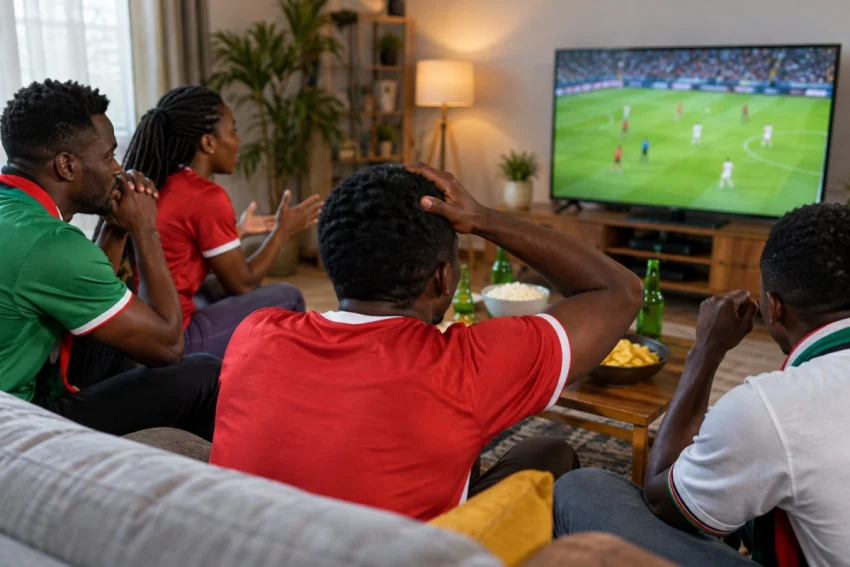
That Goal Celebration Might Be Lying to You
You’re watching the match at your local joint, phone in hand, ready to place an in-play bet the second something happens. The striker shoots, the crowd on screen erupts, and you tap “next goal” before the ball even crosses the line. Except it already has. Somewhere between the stadium and your phone, time slipped away from you.
This is the quiet reality of football betting Kenya fans deal with every weekend. Most people watching KPL, EPL, or Champions League games aren’t sitting pitch-side with a perfect feed. You’re on a shared screen at a base, a stream on your phone, or a TV broadcast that’s bounced through a few satellites before reaching you. None of that is instant.
Bookmakers, on the other hand, often work off direct satellite feeds with no buffering, no lag, no loading circle. That gap between what you see and what’s actually happening on the pitch is the whole story behind why some in-play bets lose money in ways that feel almost unfair — even when nothing shady is going on.
Why Your Screen Is Always a Few Seconds Behind
Stream delay isn’t a Kenyan problem specifically, but it hits harder here because of how most fans actually watch football. A TV broadcast typically lags 30 to 90 seconds behind real time. Mobile streams can be worse, sometimes stretching past a minute depending on your connection and the app you’re using.
Now add a shared screen into the mix. If you’re watching at a viewing center or a friend’s place, you’re often seeing a stream of a stream — someone’s phone is mirroring to a TV, or the venue itself is running a secondary feed. Every extra step adds a bit more delay.
Bookmaker trading desks don’t deal with any of that. They’re working off feeds built for speed, which is exactly why in-play odds update long before your screen shows the moment that triggered the change. You’re not imagining it when a goal odds shift suddenly and then the ball goes in ten seconds later on your stream. It already happened on their end.
This isn’t unique to one platform or one type of match. It shows up across KPL games streamed online, EPL fixtures on delayed broadcasts, and Champions League nights watched on shared connections where bandwidth gets stretched thin by everyone tuning in at once.
The Markets Where This Actually Costs You Money
Not every in-play market suffers equally from lag. Some bets are fairly forgiving even with a 30-second delay. Others punish you almost immediately if you’re reacting to something that’s already unfolded.
Markets built around a single, sudden event — next goal scorer, next card, next corner — are the riskiest when you’re betting off a delayed picture. By the time you see the buildup, the moment you’re betting on may already be decided.
Understanding which markets are forgiving and which ones punish delay is really where smarter in-play betting starts. That’s exactly what we’ll break down next.
Markets That Give You Breathing Room
Totals, match result, and Asian handicap markets tend to move more gradually. A team dominating possession, stringing together pressure, or chasing a goal doesn’t flip these odds in a single instant — they drift. That drift gives you a usable window even on a delayed stream, because you’re reacting to a pattern building over minutes, not a single moment that’s already over.
Over/under goals markets behave the same way. If a match is open and stretched, with both sides creating chances, the odds for over 2.5 or 3.5 goals shift steadily rather than snapping on one kick. By the time your stream catches up to what the bookmaker already priced in, you’re usually still within a reasonable range rather than betting on something that’s been settled for half a minute.
Half-time markets are another quieter option. Since you’re betting on an outcome that plays out over the remaining minutes of a half rather than the next ten seconds, lag matters far less. You have time to read the match, not just react to a replay.
Reading the Match Instead of Reacting to It
The fans who do well with in-play betting on delayed streams usually stop trying to beat the lag and start working around it. Instead of waiting for a shot or a corner to bet on the next event, they watch the shape of the match — who’s pressing, who’s tiring, which side keeps conceding territory in midfield.
This shift matters more in KPL matches, where stream quality varies wildly depending on the broadcaster and your location. A Gor Mahia or AFC Leopards fixture streamed through a weaker connection might run 45 seconds behind, while a well-covered EPL game on a stable TV signal might only be 15 to 20 seconds off. Champions League nights sit somewhere in between, except bandwidth gets squeezed when thousands of fans across Kenya are streaming the same fixture at once, pushing delays higher during big moments — ironically right when you’d want the most accurate picture.
Some practical habits help here:
- Avoid placing bets in the 10 to 15 seconds right after something exciting happens on your screen — that’s exactly when odds have already moved.
- Pay attention to odds movement itself as information. A sudden shift often tells you something happened before your stream shows it.
- Favor markets tied to momentum and match state over markets tied to single, split-second events.
- If you’re on a shared screen at a viewing center, assume your delay is longer than someone watching alone at home, and adjust your timing expectations accordingly.
None of this eliminates the gap between your screen and the real pitch. But it changes what you’re betting on — shifting away from the exact instant something happens and toward the broader direction a match is heading, which is far less vulnerable to the few seconds you’ve lost along the way.
Playing the Game in Front of You, Not Behind It
Lag isn’t something you fix with a faster phone or a better seat at the viewing center. It’s baked into how football travels from the pitch to wherever you happen to be watching it, and no amount of refreshing the stream closes that gap entirely. What changes is how you respond to it.
The fans who consistently get more out of in-play betting aren’t the ones reacting fastest — they’re the ones who’ve accepted the delay as a fixed cost and adjusted their approach around it. They let the quick, single-event markets go and lean into the ones that reward patience and pattern-reading instead. That’s not a workaround; it’s just a smarter way to bet when you know your screen isn’t the full picture.
Whether it’s a KPL derby on a shaky stream, an EPL fixture on delayed satellite, or a Champions League night stretching bandwidth across the country, the principle holds steady: bet on where the match is going, not on what already happened a few seconds ago. For fans who want a deeper look at how odds compilers price in-play markets in real time, resources like Pinnacle’s betting insights offer a useful window into how the other side of the screen actually works.
Get comfortable with the delay, and it stops feeling like a disadvantage. It just becomes part of how you watch — and how you bet.