
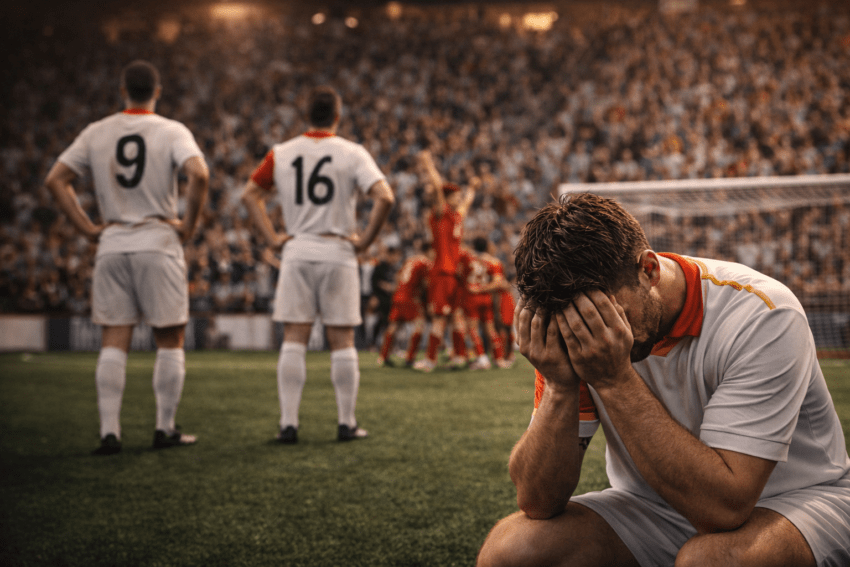
Knockout stage psychology is the invisible opponent in tournament football. We all recognize the scene: a heavy favorite dominates the group stage, then hits the Round of 16 or quarterfinal and suddenly looks stiff. Passes are slower, attacks are safer, and the “better team” feels oddly afraid of its own ambition.
This is not just a meme about “bottling it.” Knockout football changes the mental math. In a league, you can have a bad night and recover next weekend. In a knockout, a bad 15 minutes can delete four years of planning. That creates a pressure asymmetry: the underdog can play with freedom and patience, while the favorite often plays with a fear of being the headline.
FIFA’s Technical Study Group has repeatedly stressed that tournament performance is shaped by multiple interacting factors, not only tactical and physical, but also psychological themes that influence what teams dare to do in decisive matches.
Once you start watching knockouts through that lens, you stop asking “why did they choke?” and start asking “what did pressure do to their decisions?”
What “choking” really means: it is not laziness, it is attention and anxiety
“Choking under pressure” is typically defined as a performance drop when the stakes rise, driven by increased anxiety and disrupted attention. A widely cited review notes that choking explanations commonly focus on attention based mechanisms, where anxiety pushes athletes away from task relevant focus.
In football, choking rarely looks like one dramatic mistake. It often looks like a thousand micro choices that get a little worse:
- a midfielder takes an extra touch instead of turning
- a fullback chooses the safe pass, not the progressive one
- the winger crosses early to avoid losing the ball
- the striker snatches at a shot because “this is the chance”
Self focus vs distraction: two ways pressure breaks performance
Most applied explanations fall into two families:
Self focus (over control): under pressure, players start monitoring skills that should be automatic. They tighten up, move more rigidly, and lose fluid timing.
Distraction (split attention): the mind gets pulled toward consequences: elimination, criticism, legacy, social media, national expectations. Working attention gets clogged with “what if,” which reduces clarity and speed.
Favorites are especially vulnerable because the narrative already tells them they “should” win. That expectation is not just external, it becomes internal. Players feel they are defending a status, not chasing a performance.
Why knockouts amplify pressure: one mistake ends the story
Knockouts compress time and inflate consequences. Every minute without a goal increases tension for the favorite. For the underdog, every minute at 0 to 0 increases belief. This creates a psychological swing where the favorite starts playing against the clock, while the underdog plays against the mistake.
There is also the tournament environment: short recovery, unfamiliar stadiums, travel, and limited time to “fix” a bad performance. FIFA’s tournament analysis framework explicitly acknowledges that psychological trends and contextual factors can shape what we see on the pitch.
And then there is the penalty shootout shadow. Even before penalties happen, teams feel them. Once a favorite thinks “this might go to pens,” the incentive shifts from attacking to avoiding the one error that ends everything.
Six patterns of favorite collapse you can actually see on the pitch
These are repeatable patterns you can spot live. They are not moral judgments, they are pressure symptoms.
Safety first game plan
The first pattern is a favorite whose plan is built around “do not lose,” not “go win.” They keep extra players behind the ball, avoid risky passes through the middle, and choose territory over incision.
This often happens when the favorite respects the opponent’s transition threat. The irony is that the safety plan can hand the underdog exactly what it wants: a low event game where one set piece or one counter decides everything.
Sterile possession and the missing final pass
Favorites can have 60 to 70 percent possession and still feel toothless. The psychological tell is that the “final action” is delayed:
- fewer third man runs
- fewer passes between lines
- more circulation from side to side
This is pressure turning creativity into caution. The team is “in control,” but it is not brave.
Crowd and narrative pressure
Crowd pressure does not only mean boos. It can be the expectation of dominance. Fans and media narratives demand the favorite “put it to bed,” and every missed chance adds weight.
At this point, the favorite often starts forcing actions:
- early shots from bad angles
- low percentage crosses
- hopeful long balls
It looks like aggression, but it is usually anxiety in disguise.
Fear of transitions and counterattacks
Modern football punishes rest defense mistakes. Favorites know that. Under pressure, they often over correct:
- one midfielder stays too deep
- fullbacks stop overlapping
- wingers receive the ball in worse zones
Attacking becomes isolated. The favorite has the ball, but cannot get enough bodies into decisive areas. Then, when they finally push numbers forward out of frustration, they become structurally vulnerable and concede the very counter they feared.
Coach conservatism and late substitutions
Pressure affects coaches too. A common knockout story is the coach who delays attacking substitutions because they do not want to “break the balance.” They wait for the perfect moment, and the match slides into the last 15 minutes where chaos replaces structure.
This is not always wrong. But under pressure, the conservative choice is often motivated by fear of being blamed, not by the best tactical option.
Penalty shootouts: avoidance mindset vs attacking mindset
Penalties are the purest pressure lab in football. One well known study analyzing World Cup, Euros, and Champions League shootouts found links between avoidance behavior and performance under pressure.
Another research line notes how common shootouts are in major tournaments, reinforcing why teams feel the looming penalty threat in tight knockouts.
The key idea is simple:
- Approach mindset: “pick your corner, commit, execute”
- Avoidance mindset: “do not miss, do not be the villain”
Avoidance tends to produce safer, more readable shots, and more hesitation. That is choking, but it is not stupidity. It is human.
There is also debate about whether kicking first gives an advantage. Some commentary argues going second increases pressure, but newer large sample analysis finds no meaningful first mover advantage in winning probability across thousands of shootouts.
Translation: do not build your whole read on “they kick first so they win.” The psychological story is more complex.
Table: in match “tightening” signals and what they usually lead to
| What you see from the favorite | What it usually means psychologically | Typical match effect |
|---|---|---|
| Extra touches, fewer one touch passes | fear of making the error | slower tempo, easier defending |
| More sideways passing near the box | self protection, risk avoidance | fewer clear chances, low quality shots |
| Fewer runs beyond the ball | players stop believing the pass will come | sterile possession, predictable attacks |
| Substitutions delayed until late | coach prioritizes not losing | less time for changes to matter |
| Early, rushed shots | anxiety, “we need a moment” thinking | low xG, counterattack exposure |
| Increase in tactical fouls | panic control of transitions | dangerous set pieces conceded |
How elite teams reduce choking risk: routines, scenarios, and roles
The best antidote to choking is not “be confident.” It is structure.
Scenario training: teams rehearse match states. 0 to 0 at 70 minutes. 0 to 1 down at 60. Protecting a lead without inviting pressure. This makes decision making familiar instead of frightening.
Clear roles: when pressure hits, ambiguity kills. Teams that define who attacks the half space, who holds rest defense, who attacks the second post, and who takes responsibility for the final pass reduce the cognitive load.
Penalty routines: not just “practice pens,” but practice them under fatigue and time constraints, with a fixed routine per taker. Research on high pressure penalty contexts highlights how pressure protocols can alter performance, which is exactly why routine matters.
Betting lens: where the market misprices favorites in knockouts
Public money loves favorites. In knockouts, that bias can become expensive because the favorite’s true edge shrinks when:
- the underdog plays for low event football
- the favorite is under narrative pressure
- the match is likely to be tight late
Practical angles that often match “favorite tightening” dynamics:
- Underdog + handicap when you expect a close game and limited chances
- Draw or underdog double chance when the favorite is likely to stall
- Unders when both teams fear transitions and the favorite’s attack becomes cautious
- Late game volatility markets when the favorite will be forced to push numbers late
The key is to separate “best team” from “best price.” Knockouts are where psychology pulls probabilities closer together than the names suggest.
Conclusion: knockout stage psychology is a real edge when you read it correctly
Knockout stage psychology explains why the “better team” can become the tighter team exactly when it “should” dominate. Pressure changes attention, attention changes decisions, and decisions change the match. Favorites often do not lose because they are suddenly worse. They lose because they become cautious, sterile, and late to adapt, while the underdog becomes freer with every passing minute.
If you watch for the visible signals, tempo drop, missing runs, sideways circulation, delayed subs, you can understand the match while it is happening, not only after the upset goes viral. And that is where fans, coaches, and bettors all find the same advantage: clarity under pressure.
FAQ: Knockout stage psychology in football
Why do favorites look worse in knockout games than in groups?
Because the cost of a mistake is higher, and anxiety often shifts attention and decision making. Attention based choking models highlight self focus and distraction mechanisms under pressure.
Is choking just a media narrative?
Not entirely. The term is abused, but pressure driven performance drops are documented across sports. In football, it shows up in tempo, risk selection, and execution.
Are penalties a lottery?
They include variance, but pressure and behavior patterns matter. Research on shootouts links avoidance behavior and outcomes in elite tournament shootouts.
Does kicking first in a shootout decide the winner?
Evidence is mixed. Some analyses argue pressure disadvantages the second team, while newer large sample work finds no meaningful first mover advantage.
How can a favorite protect itself psychologically?
By preparing scenarios, clarifying roles, and building routines, especially for late game states and penalties. Tournament level analysis frameworks explicitly recognize psychological factors as part of performance themes.