
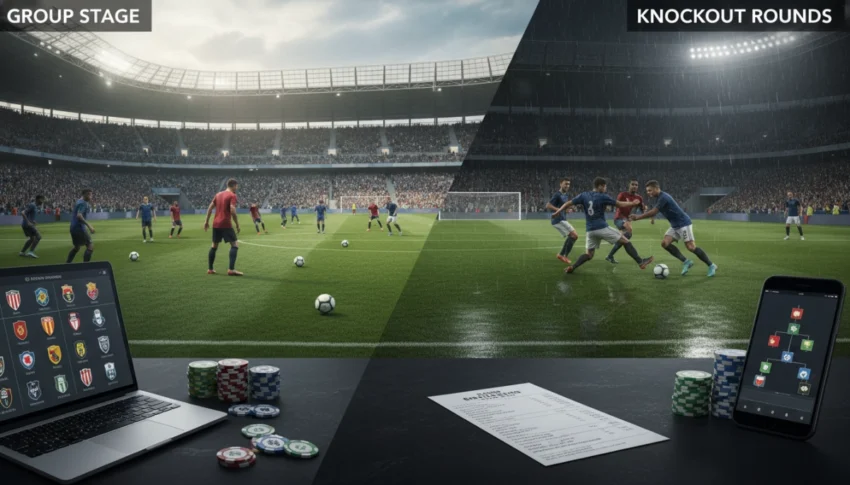
The Champions League Is Not One Competition — It’s Two
Most Kenyan bettors treat the Champions League as one continuous event from September through to the final in June. The same markets, the same logic, the same habits across every round. That approach works against you more often than it helps, because the group stage and the knockout rounds are structurally very different competitions dressed in the same badge.
In the group stage, a team can absorb a loss and recover. Six matches, points accumulate, and even a heavy defeat at home doesn’t end a campaign. That safety net changes how coaches set up, how hard teams push in the final twenty minutes, and how much risk the big clubs are willing to absorb in any single game. A side like Bayern or Real Madrid might rotate four key players in a dead-rubber group fixture simply because qualification is already secured. That’s not cowardice — it’s sensible squad management. But for a bettor who backed the favourites on a heavy handicap, it’s the reason the bet collapsed in the second half.
The knockout stage removes all of that breathing room. One tie, two legs, and you’re either through or done. That changes team behaviour fundamentally, and it changes what the most useful betting angles actually are.
What Group Stage Football Actually Looks Like From a Betting Angle
Group stage matches tend to produce more open football, particularly in the early rounds when qualification pressure is low. Teams are working out their systems, rotations are frequent, and the weaker sides in each group are often facing their best chance to pick up points before the gap in quality becomes unforgiving. That environment suits certain markets better than others.
Goal markets perform well in this phase for a reason. Both teams to score is a genuinely useful market across many group stage fixtures because even the stronger sides aren’t always set up to protect clean sheets — they’re pressing for wins, and that leaves space on the counter. Over 2.5 goals similarly reflects the open nature of these matches, though it’s worth being selective rather than applying it blindly across every game.
What works less reliably in group stage Champions League betting is heavy favouritism on match result markets, particularly in fixtures where the favourite has already qualified or is effectively safe in second place. Managers at the top clubs have long memories and longer seasons — they protect their squads, and the odds rarely account for that fully.
There’s also the matter of motivation running in unexpected directions. A side sitting third in the group with one game left might need a win desperately, while the team they’re facing has already locked in top spot. The underdog, in that scenario, has more genuine reason to press. That kind of situational reading matters far more in the group stage than it ever does in a knockout tie.
Understanding how motivation and squad rotation shape group stage results is the foundation. But the real shift in betting approach happens once the knockout rounds begin — and that’s where the conditions change entirely.
How Knockout Football Rewires the Logic of Every Market
The moment a team enters the round of sixteen, the entire risk calculation shifts. There is no points cushion, no second chance across the group, no mathematical path back if you drop three goals at home. Coaches who were rotating freely in November are now selecting their strongest available eleven, protecting their defensive shape, and thinking about the second leg before the first one has even reached half time. That behavioural change has direct consequences for how you should approach the betting markets.
Knockout football in the Champions League tends to produce tighter, more cautious first legs — particularly when the away side has genuine quality. A team visiting the Bernabeu or the Etihad for the first leg of a knockout tie is not going to open up and trade chances freely. They want to stay in the tie. A nil-nil or a one-goal game gives them everything they need going into the return fixture. That defensive discipline shows up consistently in the goal markets, and it’s why applying the same over 2.5 goals logic from the group stage into the knockout rounds will cost you over time.
The more reliable knockout betting angles tend to sit elsewhere. Asian handicaps become interesting when one side has a clear structural advantage in fitness or depth, particularly in second legs when the team with the superior squad can press without conservation. Draw no bet markets offer useful protection in first legs where quality is relatively matched and neither side can afford to overcommit. And the match result market itself becomes more readable once you understand which team is better placed to absorb the pressure of playing on the road.
Reading the Second Leg as Its Own Distinct Betting Market
One of the most consistently underexploited angles for Kenyan bettors watching the Champions League is treating second legs as genuinely separate markets from first legs, rather than simply betting on the outright winner of the tie. The aggregate score going into the return fixture shapes team behaviour in ways that are entirely predictable if you pay attention.
A team trailing by a single goal from the first leg faces a very specific set of pressures. They need to score, which means they will likely press higher and leave more space defensively than they would in a neutral context. The side defending the advantage, meanwhile, is often content to absorb that pressure and hit on the break. That dynamic consistently favours the following conditions:
- Both teams to score, because the trailing team must commit forward while the leading team has the space to exploit
- Over 2.5 goals in ties where the deficit is exactly one goal and the chasing team has genuine attacking quality
- The leading team to score first, because their counter-attacking setup against an open opponent is structurally advantageous
Where this logic breaks down is when the deficit is too large to realistically overturn. A team facing a three-goal aggregate deficit often settles into a conservative performance, protecting what dignity they have left and managing their squad for domestic competition. Betting on high-scoring second legs in those circumstances is chasing a narrative that the teams themselves have already abandoned.
The Practical Adjustments Kenyan Bettors Should Make Between Phases
Moving between the group stage and the knockout rounds isn’t just about understanding football differently — it requires a concrete change in how you select and build your bets. The information available to you changes, the team behaviour changes, and the markets that carry genuine value shift accordingly.
In the group stage, prioritise research into squad rotation patterns and each club’s genuine motivation in a given match week. A confirmed rotation from a manager’s press conference the day before a game is one of the most actionable pieces of information available to a bettor, and it consistently goes underpriced in the markets. The big clubs rotating into a dead rubber still carry short odds on the match result, even when four or five key players are confirmed absences.
In the knockout rounds, shift that research focus toward tactical matchups and fitness data. Which side has had more rest between fixtures? Which manager historically sets up to protect a lead rather than chase a bigger margin? How has each team performed specifically in away legs across the previous two or three knockout campaigns? These questions produce far more durable betting decisions than simply following the favourite based on reputation.
The transition between phases also affects staking discipline. Group stage football, with its broader spread of motivation and frequent rotation, suits smaller, more selective bets built around specific market edges. Knockout football, more predictable in terms of lineup commitment and tactical intensity, allows for slightly more conviction — but only when the situational context genuinely supports it, not simply because the match feels important.
Betting the Champions League Well Means Knowing Which Competition You’re Actually Watching
The bettors who consistently find value in the Champions League aren’t necessarily the ones who know the most about European football. They’re the ones who understand that the competition rewards different thinking at different stages, and who resist the habit of applying the same logic from August through to May simply because the tournament badge stays the same.
Group stage football is fluid, contextual, and heavily influenced by motivation gaps and rotation decisions that the odds rarely price accurately. That creates genuine opportunities — but they require situational awareness, not just an assessment of which team is better. Knockout football is more committed, more tactically deliberate, and more predictable in terms of how teams will set up. That doesn’t make it easier to bet, but it does make it more legible to anyone who takes the time to read the structural conditions before placing a stake.
The practical implication for Kenyan bettors is straightforward. Build a separate mental framework for each phase. In the group stage, let squad rotation and motivation shape your market selection before squad quality does. In the knockout rounds, follow the tactical logic of the aggregate score, the significance of the away goal, and each manager’s known tendencies under elimination pressure. Neither phase is more profitable than the other — they simply reward different preparation.
Resources like UEFA’s official Champions League hub provide reliable fixture information, confirmed lineups, and historical results that support exactly the kind of research these decisions require. The information is there. The discipline to use it differently across each phase of the competition is where the real edge lives.
Treat the group stage and the knockout rounds as what they actually are — two competitions with different rules of engagement, dressed in the same colours — and the markets begin to make a great deal more sense.