
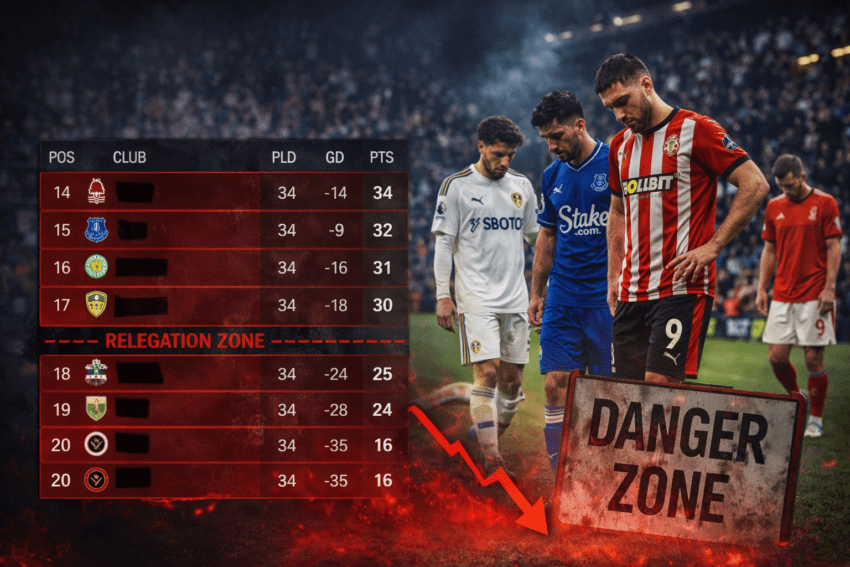
Why the relegation battle is usually misread too late
Most people identify relegation danger by looking at the table and checking who is currently in the bottom three. That is the easiest way to read the Premier League relegation battle, but it is often the least useful. By the time a team is clearly stuck in the drop zone, the warning signs have usually been visible for weeks. The smarter approach is to spot trouble before the table makes it look final.
The Premier League’s own survival update from March 31 shows exactly why this matters. Wolves and Burnley were in the relegation places, West Ham were third-bottom, Tottenham were only one point above the drop zone, Nottingham Forest were three points clear of it, and Leeds were four clear. In other words, the real battle was already wider than the bottom three itself.
That wider view is the whole point of identifying the drop zone early. It is not just about who sits 18th, 19th and 20th today. It is about which clubs are drifting toward those places, which ones are stalling, and which ones still have enough momentum to escape. In a survival fight, position matters, but trajectory matters more.
What “identifying the drop zone early” really means
To identify the drop zone early, you have to stop thinking of relegation as a static table problem and start treating it as a moving risk profile. A team can be outside the bottom three and still look like one of the biggest relegation candidates in the league. The Premier League highlighted this clearly when it described Spurs as being in danger despite sitting 17th, while also noting that Wolves, even from the bottom, had gone into the break with strong recent results.
That is the key principle. Early identification means reading danger through four questions. How big is the gap to safety? Is the team moving upward or downward in form? What does the fixture list look like next? And does the club look stable enough to handle the pressure?
If you only watch position, you will usually react too late. If you watch trend, fixture pressure and stability as well, you can often see which clubs are entering real danger before the standings look dramatic. In a long season, that difference matters a lot.
The four signals that matter most
Points gap to safety
The first signal is obvious but still important: how far is a club from safety, or how small is its cushion above the bottom three. The Premier League’s March 31 update said Wolves were 13 points from safety and Burnley were 10 points off, while West Ham sat in the final relegation place and Spurs were only one point above them. Forest were three clear and Leeds four clear.
Those numbers matter because they tell you which teams are fighting for survival in different ways. A side deep in the bottom three may need a surge. A side one point above the line may only need one bad weekend to fall in. Early identification begins by separating “chasing teams” from “fragile safety teams.”
Form trend, not just position
The second signal is form. The same Premier League report noted that Wolves had taken eight points from their last five matches, including results against Arsenal, Brentford, Aston Villa and Liverpool, and described them as the in-form side among the bottom teams. It also said Spurs remained the only Premier League club yet to win in 2026.
That is a huge contrast. One team is still in the bottom three but moving like a survivor. Another is outside it but behaving like a relegation side. This is exactly why early reading matters. Form trend tells you whether the current table is likely to hold or whether it is about to shift.
Fixture difficulty
The third signal is the run-in. The Premier League’s fixture page shows that the next round includes West Ham vs Wolves, Nottingham Forest vs Aston Villa, Sunderland vs Tottenham, and Manchester United vs Leeds. For teams near the bottom, that kind of schedule can instantly change the picture. A direct clash like West Ham vs Wolves is worth more than a normal match because it moves both sides of the fight at once.
Fixture quality matters because not all points opportunities are equal. A team with poor form but a softer sequence may still recover. A team with weak momentum and a brutal run can drop fast.
Club stability and manager changes
The fourth signal is stability. On March 31, the Premier League noted that Spurs had made a managerial change after their 3-0 loss to Nottingham Forest, replacing Igor Tudor with Roberto De Zerbi.
Manager changes can help, but they can also confirm panic. In relegation races, instability often matters as much as quality. A team trying to survive needs clarity, role discipline and emotional control. If the club looks reactive, fractured or desperate, the risk increases even if the squad still looks too strong “on paper.”
What the current Premier League table is telling us
The current survival picture is not just about the bottom three, it is about the whole danger band. According to the Premier League’s March 31 survival update, Wolves and Burnley were in the relegation zone, West Ham were third-bottom, Spurs sat 17th just one point above danger, Forest were in 16th and three points clear, and Leeds were 15th with a four-point cushion.
That means the battle is not a clean three-team problem. It is at least a six-team fight, and maybe wider depending on the next two rounds. The official article also stressed that Forest’s win over Spurs was especially important because it moved them up to 16th and opened a three-point gap to the bottom three.
The table is therefore telling us two things at once. First, Wolves and Burnley are under the clearest numerical pressure. Second, the clubs just above the line are under the most immediate psychological pressure, because one bad result can reverse their status quickly.
Which clubs look most vulnerable right now
Based on the official Premier League coverage, the two clearest danger signals belong to different types of teams.
The first is Wolves. They are still bottom, which makes the task mathematically severe, but the Premier League also described them as the strongest-form side among the bottom group, with eight points from five matches. That does not make them safe, but it does make them more dangerous to write off too early.
The second is Tottenham. This is where early identification becomes useful. Spurs were outside the bottom three, yet the Premier League highlighted that they had just been beaten 3-0 by fellow strugglers Forest and were still without a league win in 2026. It also noted the managerial switch after that loss. That is the profile of a club in active danger, even if the table still shows 17th instead of 18th.
West Ham also look highly vulnerable because they were third-bottom after losing 2-0 at Villa, while Leeds and Forest remain exposed because their cushions are still small.
Why some teams survive despite bad positions
One of the reasons the relegation battle gets misread is that people assume low position always means the worst future. It often does, but not always. Teams survive from bad positions when they show three things: improved form, emotional control, and a route through the fixtures.
The official Premier League article gives Wolves as a strong example of why the bottom club is not always the deadest club. Their recent form was better than others around them. Forest offer another version of this: one major direct win changed both their points total and their confidence level.
That is why early reading is more useful than dramatic reading. The league table shows where clubs are. Form and fixtures help explain where they are going.
A simple framework for reading the run-in
If you want a clean way to read the Premier League relegation battle from here, use this four-step framework:
First, mark the current bottom three.
Second, include every team within four points of safety.
Third, separate strong recent form from weak recent form.
Fourth, look at the next two fixtures and ask whether they are direct survival games or likely damage-limitation matches.
Using the official Premier League update, that framework immediately pulls Wolves, Burnley, West Ham, Spurs, Forest and Leeds into one danger group. Using the next round of fixtures, you can then see where the pressure spikes fastest, especially in direct-impact matches like West Ham vs Wolves.
That is the practical meaning of identifying the drop zone early. It is not prophecy. It is structured risk reading.
Conclusion
The Premier League relegation battle is rarely decided by table position alone. The sharper way to read it is through points cushion, form trend, fixture stress and club stability. Right now, the official Premier League picture shows Wolves and Burnley in the bottom three, West Ham still inside the drop zone, and Spurs, Forest and Leeds all close enough to be in real danger.
So the drop zone should be read as a live pressure area, not a fixed list. The clubs most at risk are not always the ones lowest today. Sometimes they are the ones just above the line, sliding at the wrong time.
FAQ
What does “identifying the drop zone early” mean?
It means spotting relegation danger before the bottom three become fixed, using points gap, form, fixtures and stability, not just current position.
Which teams are currently central to the Premier League relegation battle?
The Premier League’s latest survival update identified Wolves, Burnley, West Ham, Tottenham, Nottingham Forest and Leeds as the key clubs in the fight.
Why is 17th sometimes more dangerous than 18th?
Because a team can be outside the drop zone but still have worse momentum. The Premier League noted Spurs were one point above the line yet still without a league win in 2026.
Why do direct fixtures matter so much?
Because they change both sides of the battle at once. The next round includes West Ham vs Wolves, a match with immediate survival consequences.
Can teams in the bottom three still survive late in the season?
Yes. Wolves are the clearest current example of why the table alone is not enough, because the Premier League highlighted their strong recent form despite being bottom.
How much does a manager change affect the survival race?
It can help, but it can also signal instability. Spurs’ switch from Igor Tudor to Roberto De Zerbi came immediately after a major defeat to a fellow struggler.